
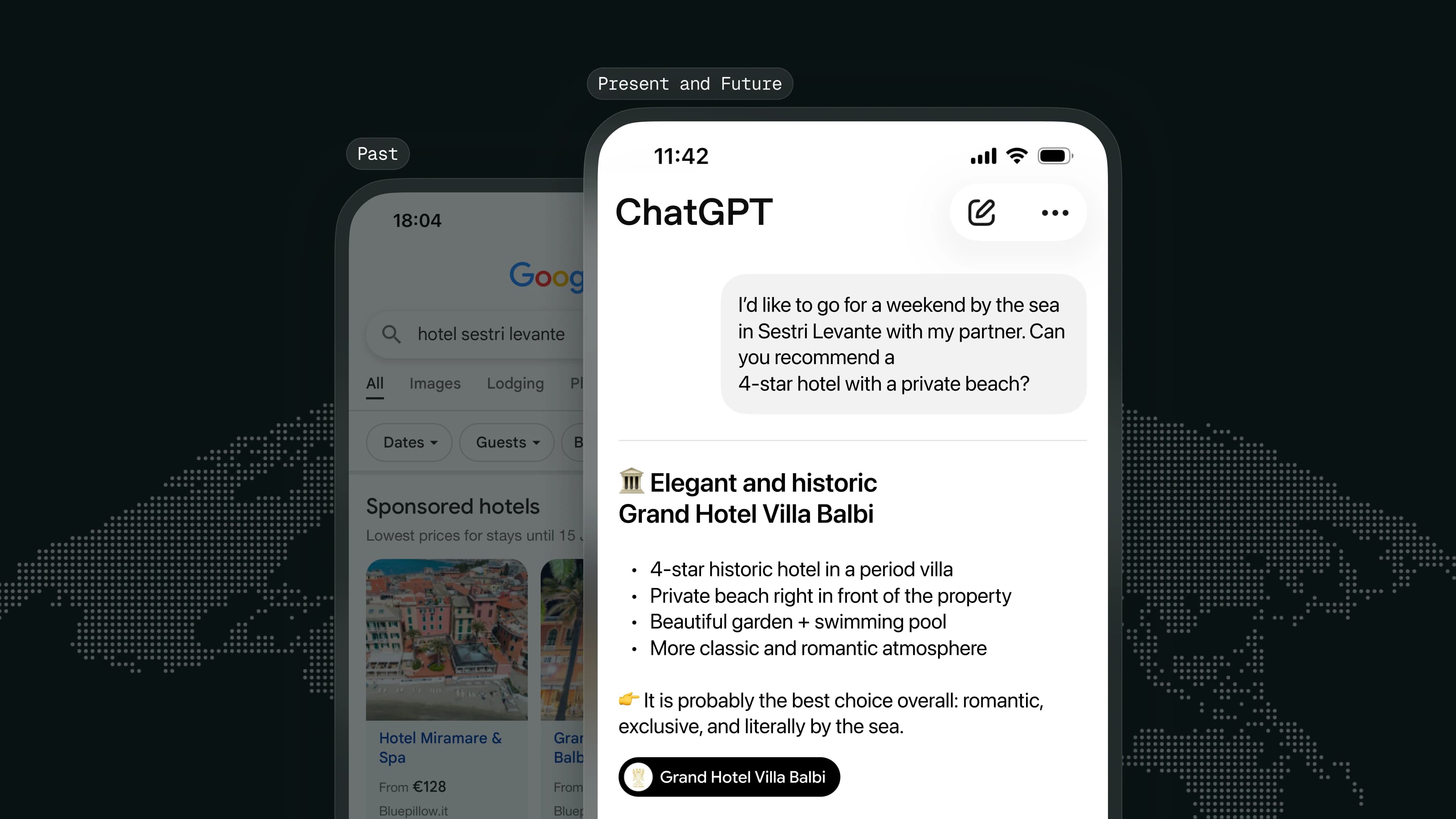
In hospitality, it’s no longer enough to appear, you need to be the source AI chooses.
For years in hotel marketing, we told ourselves a fairly simple story. Be present. Be visible. Rank on Google. Improve positioning. Drive traffic to the website. Hope that traffic would turn into a direct booking instead of another round through OTAs.
It was an imperfect story, but at least it was linear.
Today, that linearity is breaking. And not because of a technical detail, but because of a deeper shift — one that concerns how people search, compare, and decide. It also concerns the way machines are starting to act as a filter between a question and an answer.
For a hotel, the point is no longer just to be one of the results inside a SERP. The point is to become the reference that artificial intelligence considers reliable, clear, and consistent enough to use as an answer.
It sounds like a nuance. It is not.
Because between being a result and becoming a reference, there is a cultural leap that many hotels still have not understood. And, to be direct about it, many consultants are still explaining it poorly.
Before, you wanted a click. Now you have to earn trust
The old game was fairly clear. Appear, attract, convince, convert.
The new game is more uncomfortable. You need to be understood before you are even clicked. You need to be accurately read by systems that summarize, interpret, connect information, evaluate consistency and inconsistency, and then decide whether you are worthy of being included in the answer.
Translated into plain language, it is no longer enough just to be there. You need to appear credible.
We are not talking about the usual SEO with a new name, a colorful slide, and three conference acronyms. We are talking about something more serious. The evolution of referencing no longer rewards only those who are technically optimized. It rewards those who build a digital presence solid enough to be taken seriously.
And this is where everything falls apart.
Because part of the hotel industry still has an immature relationship with content. It sees it as filler. Something to have. Pages to complete. Texts to publish just for the sake of it. FAQs to paste in. Descriptions stretched until they all sound the same.
Then people act surprised when the hotel does not truly stand out. Or worse, when someone else always does.
AI does not choose the loudest. It chooses the most readable
This is the part that should be printed and hung in quite a few marketing offices.
Artificial intelligence does not need slogans. It does not get emotional because you wrote “oasis of relaxation” or “unique experience.” It does not buy inflated formulas, brochure clichés, or the plastic language that too many hotels still use to seem desirable.
AI needs to understand.
Understand who you are. Understand what you offer. Understand who you are right for. Understand where your real strengths are. Understand whether what you say matches what others say about you. Understand whether your digital identity actually holds together or not.
And to understand, it needs three things — far less glamorous than certain webinars about the future of tourism, but far more useful.
Relevance, because you need to truly match the request. Completeness, because you need to explain yourself clearly, without gaps. Trust, because if your data is inconsistent, vague, or contradictory, no serious system will choose you as a strong reference.
The new form of referencing is, ultimately, this. Not a contest of who shouts the loudest. A selection based on who offers the least ambiguity.
A hotel must no longer just tell its story. It must become a source
This is the real novelty.
For years, the official website was treated like a storefront. Often a poor one. With copy-paste pages, texts that say nothing, beautiful but silent images, destination sections written like middle-school essays, and room descriptions built with the imagination of a property registry form.
But a storefront is no longer enough.
Today, a hotel must become an authoritative source of information about its product, its context, its promise, and its real experience. It must leave behind organized, consistent, readable, and verifiable traces online. It must stop communicating through empty phrases and start communicating through strong signals.
This is not a technical issue. It is a matter of maturity.
Because when an AI system has to recommend a property, it does not choose only who wrote the better headline. It chooses who appears most reliable overall. And that overall picture is made of website, reviews, Google Business Profile, OTA presence, booking engine, local content, images, structured data, external mentions, and consistency in detail.
Those still working in silos are already behind. Those who continue separating SEO, copywriting, reputation, local, UX, and brand presence as if they were different rooms in the same house simply have not understood where we have arrived.
The practices that truly make the difference
This is where it is worth being concrete. Not to create the usual checklist, but because without execution, the conversation remains unfinished.
1. Structured data is not an optional extra for nerds
Schema.org is not a technical obsession. It is one of the few clear ways a hotel has to tell a machine what a piece of information represents.
If you limit yourself to basic markup, you are saying very little. If you properly structure rooms, services, restaurant, events, accessibility, and offer-specific details, you are reducing ambiguity.
And in the world of AI referencing, reducing ambiguity is already a competitive advantage.
2. Conversational queries are not a trend
People no longer search only for “Lake Garda spa hotel.” They search with intentions that are more nuanced, more situational, more human.
They look for a quiet hotel that is not isolated. A place with convenient parking. A property suited for couples who want to relax without needing a huge, crowded spa. A room where you genuinely sleep well. A breakfast that does not feel designed to finish a shift, but to welcome guests.
If you do not build content capable of capturing needs like these, the problem is not that you lose a keyword. The problem is that you lose relevance.
3. Reviews are your real vocabulary
Many hotels read reviews only to see whether the average score goes up or down. That is a limited view.
Reviews are a semantic goldmine. They tell you what truly stays in guests’ minds. They reveal whether you are perceived for the silence, the view, the kindness, the bed, the breakfast, the location, the ease of parking, the human warmth, or the coldness.
If dozens and dozens of people repeat certain concepts, AI does not treat them as random details. It treats them as identity signals.
The brand says who it thinks it is. Reviews reveal who it actually was for guests.
And often, the latter matters more.
4. Google Business Profile must be treated as an editorial asset
It is not a profile to set up and forget. It is a decisive source of information.
Posts, updates, services, attributes, photos, and above all questions and answers help build a public, readable, and often almost institutional version of your hotel.
Those who leave that profile half-finished, outdated, or neglected are leaving room for approximation. And approximation, when a system must decide whom to trust, becomes a boomerang.
5. The destination is not filler
The classic poorly written “surroundings” page is one of the great monuments to carelessness in tourism marketing.
A hotel that knows how to tell the story of its destination well is not just doing content marketing. It is demonstrating knowledge. It is creating a semantic connection with a place. It is becoming a guide.
And a credible guide is more likely to be referenced than a property that only knows how to talk about itself.
6. Brand citations matter more than many think
The name of your hotel appearing in articles, blogs, local portals, quality forums, editorial content, and relevant conversations, even without a direct link, leaves a trace.
AI reads that trace. It contextualizes it. It connects it with other signals.
If your brand appears in coherent and positive contexts, you are building distributed reputation. Not always measurable with the usual report metric, but extremely valuable in building authority.
7. Inconsistencies kill trust
This is the most basic point — and the most ignored.
If your website says one thing, your Google Business Profile says another, Booking shows a partial variation, your booking engine says something else again, and your social channels add yet another version, the system does not perceive you as rich in information. It perceives you as confused.
Consistency today is not a refinement. It is a minimum requirement.
8. Images must be readable, not just beautiful
A generic alt text helps no one. A precise description, on the other hand, supports accessibility, understanding, and contextualization.
AI does not look at your photos with a photographer’s eye. It needs signals. And those signals also come through descriptions, captions, organization, and textual context.
9. Monitoring how AI describes your market is not paranoia
It is common sense.
If you start observing how certain engines and assistants describe a destination, a segment, or a specific type of experience, you also begin to understand which interpretive frameworks are emerging.
And if you understand them early enough, you can create better content. Not to chase the trend of the moment, but to enter the right conversation first.
10. Technical foundations still matter
Anyone claiming that technical foundations matter less in the AI era is selling smoke with updated vocabulary.
A slow, unstable, frustrating mobile experience or a poorly built website still sends a signal of low quality. And no serious artificial intelligence should recommend an experience that already starts badly at the very first touch.
Technical excellence is not enough. But without it, everything else loses strength.
The real issue is not the algorithm. It is your credibility
It is worth pausing here for a moment.
The risk, as always, is that the industry takes this conversation and turns it into yet another caricature. A new race for tricks. A new binge of optimizations. A new package sold as a magic formula to please AI.
That would be the usual mistake. The problem is not pleasing the algorithm.
The problem is building a presence so clear, consistent, and useful that it naturally appears worthy of trust.
From this perspective, AI does not invent a new truth. It only makes stricter a truth that has always existed in hospitality.
The properties that perform best are the ones that maintain consistency between promise and reality. The ones that explain themselves well. The ones that reduce friction, confusion, and ambiguity. The ones that know how to leave recognizable signals of reliability.
Only now, it is no longer enough to convince the guest. You also have to convince the system that, more and more often, will act as the interpreter before the guest does.